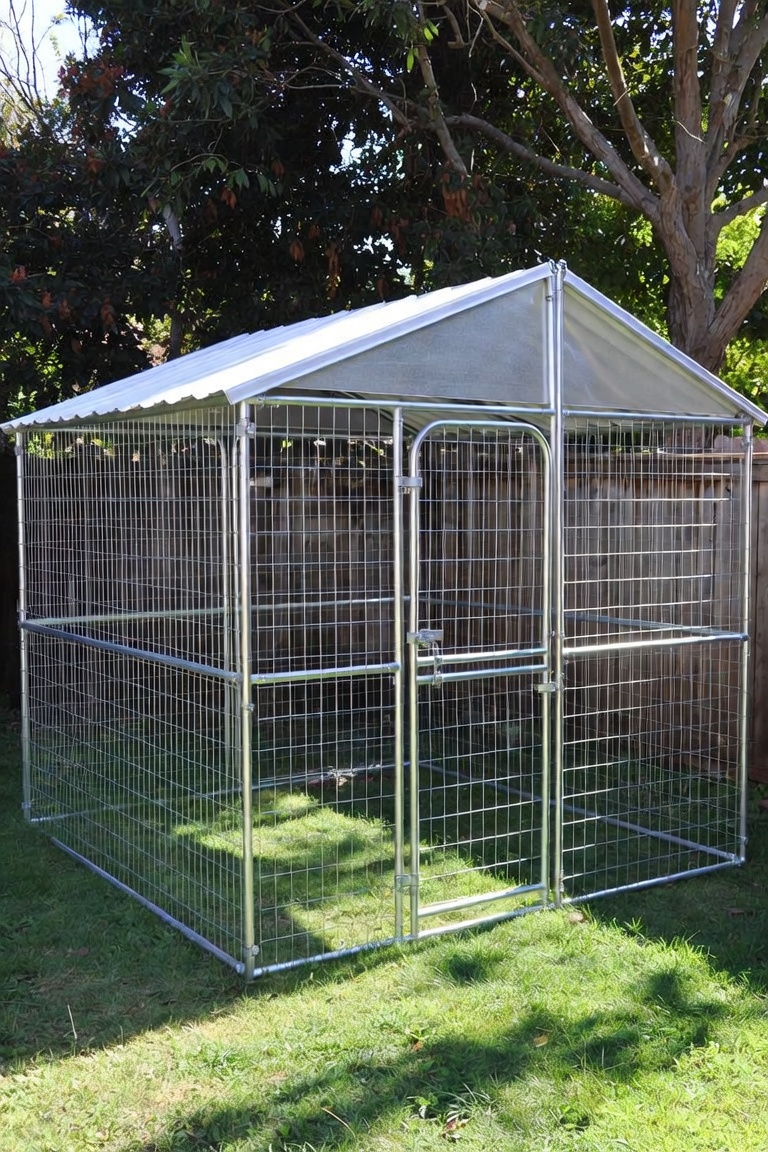
An outdoor kennel or run can be one of the best purchases you make for your dog — a safe, contained space for fresh air, backyard time, and supervised independence. It can also be a frustrating one if you get the sizing or materials wrong. Here's what to know before you buy.
Kennel vs. Run: What's the Difference?
The terms get used loosely, but generally a kennel is an enclosed structure (often with a roof or the option to add one), while a run is a larger open-air enclosure focused on space to move. Many products blur the line. What matters isn't the label — it's whether the footprint, height, and build match your dog and your yard.
Sizing: Bigger Than You Think
The most common mistake is buying too small. Minimums to work from: your dog should be able to stand fully, turn around easily, stretch out flat, and take at least a few strides. For anything beyond brief use, aim well past that — a run of 100+ square feet gives a medium or large dog genuine room to move rather than just stand around.
Height matters too. Jumpers and climbers need panels tall enough that the top isn't an invitation. For athletic breeds, 6-foot panels are the safe default.
Multi-dog households or dogs that need separation (feeding time, a new rescue settling in, intact dogs) should look at multi-room designs — a divided kennel lets dogs share space safely without sharing all of it.
Materials: Where Durability Actually Lives
Galvanized steel is the standard for a reason: it resists rust, stands up to weather, and — critically for the chewers we know well — can't be gnawed through. Powder-coated steel adds another layer of weather resistance.
Chain link vs. welded panels. Chain link flexes, which determined dogs learn to exploit. Welded or framed panels hold their shape and their boundaries.
Avoid lightweight wire exercise pens sold as "outdoor kennels" for anything unsupervised — they're travel gear, not containment. And skip wood-framed enclosures for chewers; wood is a project, not a barrier.
The Details That Make or Break It
The door. A lockable, latching door is non-negotiable. Dogs are smarter than latches; raccoons are smarter than dogs. A lock solves both.
Flooring. Bare grass gets destroyed and muddy fast. Diggers need a dig-proof base — pavers, gravel over hardware cloth, or a concrete pad. Whatever you choose, it should drain.
Shade and water. An outdoor kennel in full sun is unusable for much of the day, especially in hot climates — we're in the Palm Springs desert, so we take this one personally. Position for natural shade or add a shade cloth/roof panel, and always have water available inside the enclosure.
Assembly and footprint. Measure your space before ordering, including gate access to get panels into the yard. Most quality kennels bolt together with basic tools in an afternoon.
What an Outdoor Kennel Is Not
A kennel is a safe space, not a storage solution. Dogs shouldn't live in an outdoor run full-time or be left in one for long unsupervised stretches — it's for backyard time, potty breaks, work-from-home sanity, and keeping dogs safe during yard work or open-gate moments. Pair kennel time with the exercise and enrichment your dog needs, and it becomes a space your dog actually likes.
The Bottom Line
Get the size generous, the steel galvanized, the door lockable, and the shade sorted, and an outdoor kennel will serve you for a decade. Cut corners on any of those and you'll be shopping again next summer.
See our current kennel lineup in the Kennels & Containment collection — and watch real setups on TikTok @mutt.toy and the Mutt Toy YouTube channel.

